PET Tape vs. Washi Tape: A Deep Dive into Material Science, Manufacturing Technology, and Market Positioning
As a manufacturer with decades of expertise in washi tape production, we’ve witnessed the handcraft culture evolve from niche subculture to mainstream consumer phenomenon. In today’s increasingly segmented adhesive tape market, PET tape has rapidly emerged as a formidable competitor, creating distinct differentiation from traditional washi tape through technical innovation. This article provides a systematic analysis of their fundamental differences across material properties, manufacturing processes, and application scenarios, offering actionable insights for industry professionals.
1. Material Genetics Determine Product Characteristics
Washi tape derives its competitive edge from the harmonious balance between “paper properties” and “adhesive performance.” Taiwan’s Daian Printing pioneered the 501 Kikusui series using long-fiber washi paper treated with proprietary impregnation technology, achieving 30% improved elongation. When paired with water-based acrylic adhesive, this creates a unique “high initial tack, stable holding power, residue-free removal” profile. In automotive painting applications, the tape maintains adhesion for 2 hours at 110°C without leaving residue, making it an industry standard for masking operations.
PET tape, built on polyester film substrate, exhibits “plasticized” physical properties. 3M’s JM605P2 model features 0.012mm ultra-thin PET with modified acrylic adhesive on both sides, delivering “high rigidity, high-temperature resistance, and high light blocking” capabilities. Laboratory tests confirm 24-hour adhesion at 120°C without failure, with the black version achieving 99.9% light blocking – essential for LED backlight module fixation.
2. Manufacturing Process Shapes Product Morphology
In printing technology, washi tape has developed sophisticated composite processes:
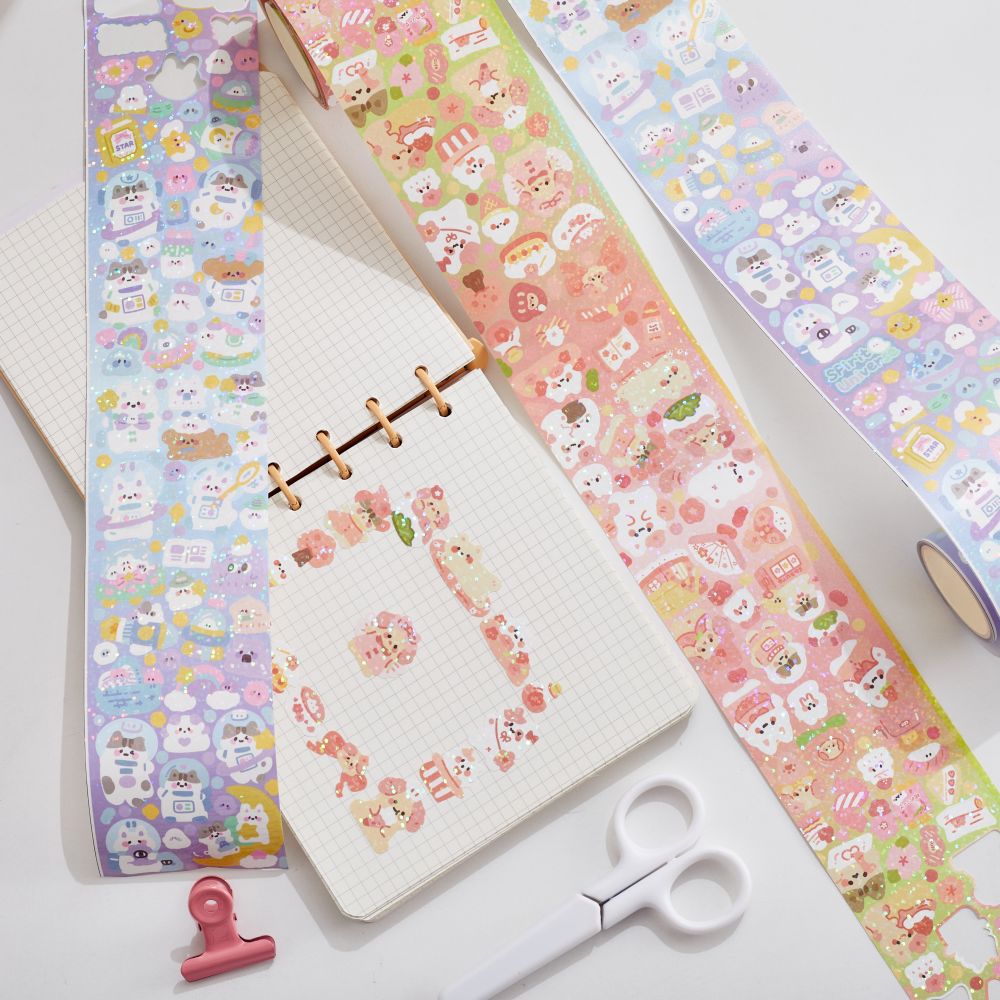
• Specialty coatings: The “Starry Night” series by ZHIYU Studio employs Daian’s patented UV gloss coating, achieving 35μm ink layer thickness through six-color registration printing. This creates 3D nebula effects visible under directional lighting. The process requires substrate surface roughness below Ra0.8μm to balance ink adhesion and dimensional stability.
• Functional additives: Some industrial-grade washi tapes incorporate calcium carbonate fillers to increase opacity by 40% while maintaining flexibility, enabling single-layer masking for automotive body painting.
PET tape focuses on precision engineering:
• Surface treatment: TESA 4982 applies matte finishing with micro-scale surface roughness (Ra1.2-1.5μm), increasing light diffusion by 40% to eliminate glare in high-ambient-light environments. This meets ISO 13655 optical standards for mobile screen assembly.
• Dimensional control: Foxconn-qualified JM1030B maintains substrate thickness tolerance within ±0.001mm, enabling 0.02mm die-cutting precision for FPC reinforcement applications.
3. Application Scenarios Drive Market Differentiation
Washi tape dominates three cultural-creative segments:
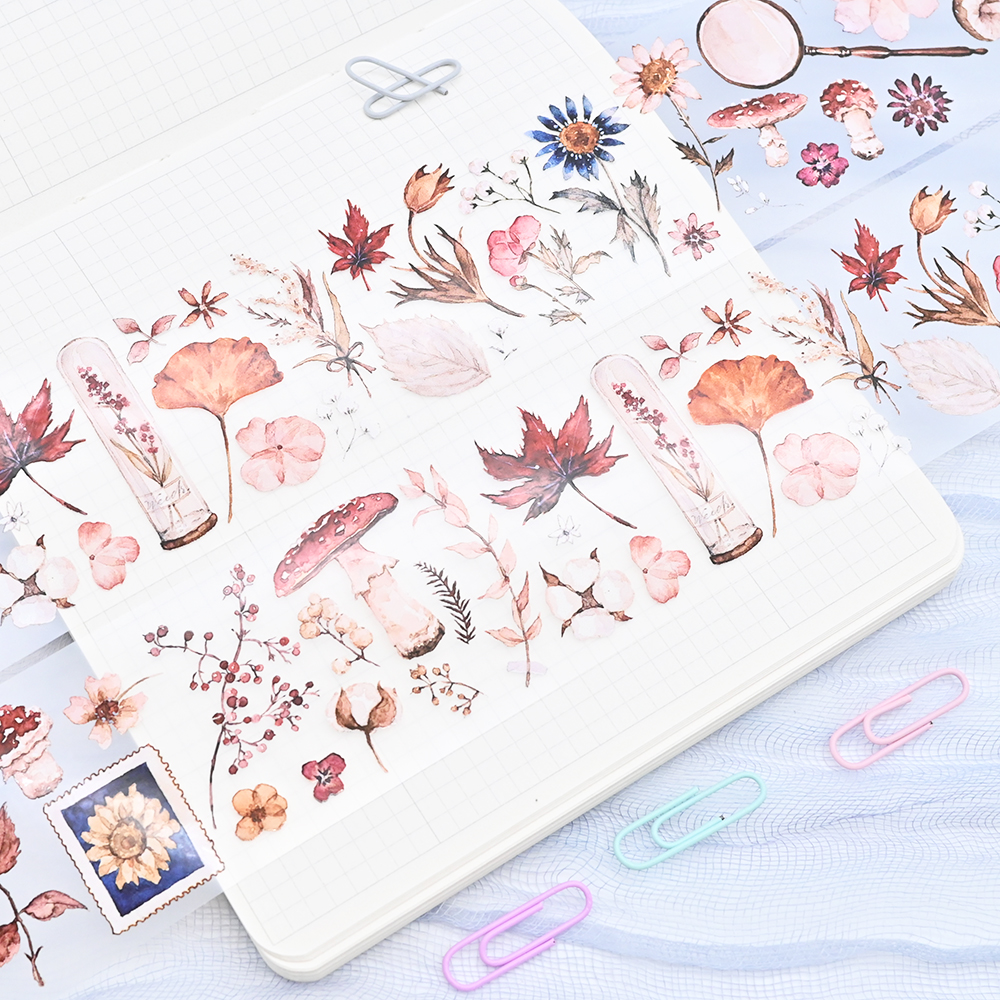
• Journal decoration: Taiwanese社团 (club) tapes feature extended pattern cycles (90-200cm/roll) with thematic continuity. The “Sakura Feather” series by KIKEN combines white ink, gloss coating, and hot stamping in 12 sequential designs, supporting narrative-driven scrapbooking.
• Gift wrapping: Japan’s MT brand developed 48mm wide formats utilizing washi’s pliability for 3D bow-making. The adhesive’s 0.8N/25mm peel force ensures stable positioning during automated packaging.
• Industrial masking: Daian 701 series optimizes unwinding force below 0.8N/25mm for compatibility with high-speed automated masking equipment in electronics manufacturing.

PET tape excels in precision industrial applications:
• Electronics assembly: 3M 9795B achieves 92% light transmittance with <1.5% haze using optical-grade PET, meeting automotive display bonding requirements.
• High-temperature processes: SIDITEC DST-20 maintains structural integrity at 200°C for 30 minutes, preventing carbonization in new energy vehicle battery insulation.
• Microelectronics: PET tapes with 0.003mm thickness tolerance support semiconductor wafer handling, where dimensional stability directly impacts yield rates.
As the adhesive tape industry transitions from “material competition” to “system solutions,” understanding the technical rationale behind material properties becomes more strategic than mere parameter comparison. At our washi tape production facilities, we’re establishing a “Material Database + Process Lab” innovation system to explore functional washi applications while preserving traditional craftsmanship. This dual approach of heritage preservation and technological disruption may represent the optimal path through industry transformation.
Post time: Sep-18-2025